19 de noviembre de 2010

11 de noviembre de 2010
Festivals in Bogota: Festival de Verano 14 (:
 The " Festival De Verano" began in 1997 and since then is the hub for the celebration of the birthday celebrations of the city from a recreational-sports theme, since its inauguration coincides with the date of founding of Bogotá (August 6) and extend for 11 days.
Some of the innovations to be presented in this edition will be the Aquatic Balle de Cuba, the Florida Star (nautical skilled skiers make figures and pyramids on the water), and original characters Kids Discovery Kids Channel. As for sport, will take place on the Pan American Softball Championship, the International Skating Gala and the Grand Prix International Billiards, among other events.
The event, which gathers more than three million citizens who are members and viewers of its programming, has been strengthened by the following aspects:
▪ It is the most massive and extensive to be held in Bogotá, calls for millions in a few days. Admission is free, and the quality of events, guest artists and participating athletes do a space suitable for all audiences.
▪ It has become the party more representative of the country's capital, perhaps considerable festivities as the Feria de las Flores for Medellin, the Carnival of Barranquilla, Cali Fair or Carnival of Blacks and Whites to Pasto.
▪ Due to these reasons and importance for the sense of ownership of Bogota and Colombia, the Summer Festival is considered "cultural event" for the city as the Agreement signed in Council 125/2002 of Bogota and "Event of social, cultural and sports within a national framework," according to Law 904/2004 of Congress.

Festivals in Bogota: Rock Al Parque (:
 The festival began in 1995, having its origin in Juvenile Music Meetings were held at the Planetarium since 1992 as an initiative of the singer Mario Duarte member of the defunct band The Right who sought the support of the Institute of Culture Bogotá and Tourism (IDCT) and the cultural entrepreneur Correal July with the aim of promoting the country rock bands and at the same time promote programs of coexistence and tolerance among youth in the city. And the festival was held from 26 to 29 May in various venues such as outdoor theater of La Media Torta, a Simon Bolivar Park, the stadium Olaya Herrera, Plaza de Toros La Santa Maria, the latter still the only place where he claimed the entry.In 1996, the festival is held the second edition of deleting the scene of the Plaza de Toros at the festival becomes free.In 1998, the festival is in danger of disappearing due to IDCT officials do not see the event as a priority for the city's cultural development, but the initiative is reversed to see young people and public opinion in general protest supporting the festival. Finally, it is saved in the City of Bogota, the city's legislative body, and declared the city's cultural heritage.Parallel to the main event with live performances, they develop different activities such as seminars, workshops, lectures and master classes scheduled, including academics and several guests.The festival initially only specialized in rock bands, was gradually extended to include other genres such as punk, reggae, ska and blues among others, due to this diversity are scheduled days in the majority of bands playing different genres to rock.Currently, the festival runs over three days in the Simon Bolivar Park where they set two scenarios (three scenarios in 2009) in which bands are different genres simultaneously, the festival is broadcast live by Channel Capital and station Radionics are also held interviews with the participants after the presentations.
 Rock al Parque is an international rock festival that takes place in the city of Bogotá, Colombia, since 1995. The festival is free and open-air Latin America's largest.
It is part of the series of festivals promoted by the Park District Department of Culture, Recreation and Sport, is the oldest and the one that started the cycle of festivals, their scheme after being emulated with different themes and genres such as Salsa, Jazz , Hip Hop, Opera, Operetta and others.
The last rock al parque was the one of the 2010 that has an especific image but each year since 1995 had his own picture.
This festival have been the result of ot of years of work and we must enjoy it without trying to find trouble.

Libraries in Bogota: Julio Mario Santodomingo (:

This is a really new library it was inagurated on May the 27th its characterized because of been the largest in the network of libraries that have Bogotá, with this construction is complete 4 Libraries: Tunal Tintal, Virgilio Barco and Julio Mario Santo Domingo.
The architect was Daniel Bermudez who also participated in the design of the library Tintal his particular stamp is in the use of white concrete and management of natural light on the artificial, giving importance to users and their comfort on campus.
"That over there is the cornerstone and will be in memory." It is a white
rock which marked the beginning of construction, three years ago and is
now a reality with two theaters, Internet, games room, and bebeteca
Sonoteca.Red is part of the District Public Library and is the fourth
megalibraries (the others being The Tintal, Tunal and Virgilio Barco).
The vast majority of activities are free and Internet use.
rock which marked the beginning of construction, three years ago and is
now a reality with two theaters, Internet, games room, and bebeteca
Sonoteca.Red is part of the District Public Library and is the fourth
megalibraries (the others being The Tintal, Tunal and Virgilio Barco).
The vast majority of activities are free and Internet use.
The infrastructure cost 55 billion dollars, donated by the Santo Domingo family, courage to sit on its 23 thousand square meters of construction. The District donated 32,000 million pesos were invested in parks, the Park San Jose de Bavaria and road construction and water supply.
In the large terrace, Bermudez sa
id the distance:

id the distance:

Libraries in Bogota: Luis Angel Arango (:
 Besides library is a cultural center has auditorium (where exhibitions, concerts and lectures on various topics), audiovisual resources (called multimedia) and two permanent exhibitions, the Museum of Religious Art (where are the custodians of the Onionand Clarisa , clear demonstrations of the power of the Church in colonial times) and a small exhibition of instruments, whichhighlights some instruments native to the Amazon.The library was named after the person who in 1955 decided to move to a new building and died before the work is finished.
After that in the 80's it was decided that the National Library wasonly accessible to college students, Luis Angel (remodeled in 1990) became the largest library's public access Bogotá.
The Luis Angel Arango, owned by the Bank of the Republic, is one of the main libraries of the city. According to the Bank of the Republic, is the second library in the world with more users, slightly distorting the theory that we are lazy to read.
Things to take into acount:
At the library you can not enter with suitcases and bags. There is a service to let them saved, but they tend to generate long lines to use. It recommends, therefore, carry only notebooks.

There is a service, the "Economic Plan" that allows you to pay $ 31,200 pesos (February 2007, was $ 30,000 in September 2006) for the library to provide up to 3 books for 7 days and giving access to promotions on events, publications of the Library and other activities of the Bank of the Republic.
Chapinero !!
 Chapinero is the location number two in the Capital District of Bogota. It is located northeast of the city.
The area called Chapinero traditionally includes the town of Chapinero and part of Teusaquillo and Barrios Unidos, since it is the only place in Bogotá whose territory beyond its perimeter (a kind of suburban area), as is the case of Western Chapinero Teusaquillo and Chapinero Los Alcazares in the Barrios Unidos. Commonly the territories of Chico, El Lago, Catalonia and the rest of the town to the north and the eastern hills of the town are not included on this traditional name, as a matter of cultural influence.
 The total area of the town is 3,898 hectares and the urban area is 1,349 hectares. This makes the town is located in the twelfth position in the urban area of the city.
*North Street 100, with the town of Usaquén.*South: Avenida 39, with the town of Santa Fe*West: Highway north and Avenida Caracas with the locality of Barrios Unidos and Teusaquillo.*East: Eastern Hills with the municipality of La Calera (Cundinamarca).

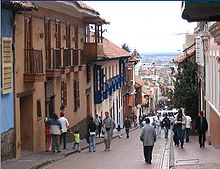
La Candelaria :) !!

La Candelaria is located within the city of Santafe. Its boundaries are determined:
*From the North: The environmental axis (San Francisco River).
*To the south, Fourth Street.
*For the West: the tenth race.
*To the east: Circunvalar Avenue, up the Carrera 4 east and further north around the neighborhood includes Egypt and down again to connect to the Avenida Jimenez in the cable car and funicular.
El Corral
El Corral
El corral is a delicious restauran, there gave hamburgers and many things.The food is different by the other restaurants because the preparation is so good. I go many times with my friends and family. my mother like so much this restaurant. I like it too so much and we go many times there. EL corral is a restaurant that have many time working here in Bogotá, many people love it and go a lot of times to this restaurant.

There are a lot of restaurants of el corral and are located in many parts of Bogota because the ones that work in that restaurant wants that all the people now how delicious is.

Well, all the people that go to El Corral restaurant know that is so delicious, and have to recomend the people that has not been yet, that fence and make sure the Corral is one of the best sites for quality and everything.

El corral is a delicious restauran, there gave hamburgers and many things.The food is different by the other restaurants because the preparation is so good. I go many times with my friends and family. my mother like so much this restaurant. I like it too so much and we go many times there. EL corral is a restaurant that have many time working here in Bogotá, many people love it and go a lot of times to this restaurant.

There are a lot of restaurants of el corral and are located in many parts of Bogota because the ones that work in that restaurant wants that all the people now how delicious is.
Well, all the people that go to El Corral restaurant know that is so delicious, and have to recomend the people that has not been yet, that fence and make sure the Corral is one of the best sites for quality and everything.
4 de noviembre de 2010
Sports 1
In Bogota's city also peopple practice sports. There are so many sports that people do, many people considered it like a custom of the weekends.

People practice sports to have a good health or to loog good. Always the sports have a time to practice, like rules to use and don't do it bad too. The sports in Bogota are many, like to practice football, boleyball, basketball, swimming, running that many people do that, golf, ciclys, skating, and many many many many moore!
 |
 |

We can include the extreme sports that in Colombia and others countries do it. In Bogota is not so much used this sports, but sometimes we can see people doing this sports, like the skydiving, bungee, paragliding, skateboarding, paintball, motocross. Mainly this sports here in Bogota, people pratice it is to pass fun and spend time in free time.
 |
 |
22 de octubre de 2010
The Militar Museum :)
In the Militar Museum you can see many things, but you dont have to pay anything for it.

In the militar museum is located in the calendaria of bogota, if you go there is a gide person that can tell you about for it, also you can see many thing like the maps they have there is very interesant to go and learn about it, the first time that we go mi family dont know ans see and enter ans is very interesant.
Also we can watch the worn that the military use depending on the time they are, also you can see many history but you cant take any photo except one that we can take it thta is the one of the boat you can see down of the information that boat is built many years ago.


Also you can see the helicopters and the airplanes that they use, you can see at down you can see one of the helicoptres they use on that time any body cant enter in so for that reason you can see the red band, and the Airplanes they use it to bomb or firing with the countries they are in war.

 And on my left side you can see the weapons they use to kill the persons t¡in that time but that weapons wost of the time are guns with many power.
 Libraries In Bogota (: (Virgilio Barco )
 The Virgilio Barco is one of the most famous libraries in Colombia. Its characterized because of his advanced architectural design. This library was designed by Rogelio Salmona one of the most famous Archuitects in Colombia. The Library opend its doors on December the 20th of 2001 to the public. From that moment on, this library become not only a very cultural but recreative and social place in which you can socialized with new people family or friends.
Monday Tuesday Wednesday Thursday Friday Saturday Sunday Holiday2:00 pm - 8:00 pm 8:00 am - 8:00 pm 8:00 a.m. to 8:00 pm 8:00 am - 8:00 pm 8:00 a.m. to 8:00 pm 8:00 am - 8:00 pm 9:30 a.m. to 5:30 pm No serviceThe schedule of membership services, loan of library materials and copy ends fifteen minutes before the closing of libraries.

Virgilio Barco Library, a space that took the name of a former Colombian president, is undoubtedly one of the best architectural works of Colombia. Located west of Bogota, in the so-called geographical heart of the city.
It is a work designed by French architect, Colombian citizen, Rogelio Salmona, in 2002 by builder District Library Consortium, formed by the firm Conconcreto SA and Cusezar SA .
Its construction is in an area of 16,092 meters square. General has a room built on 3 levels, reading room, 640 seats for reading, newspaper reading cubicles, library, computer room, digital catalogs, research areas, internet and multimedia.
It also has an outdoor auditorium with capacity for 350 people and music halls, exhibitions and information on Bogotá and a child living with capacity for 100 children, where puppets and playroom.And a terrace where you can see much of the city
.

Suscribirse a:
Entradas (Atom)